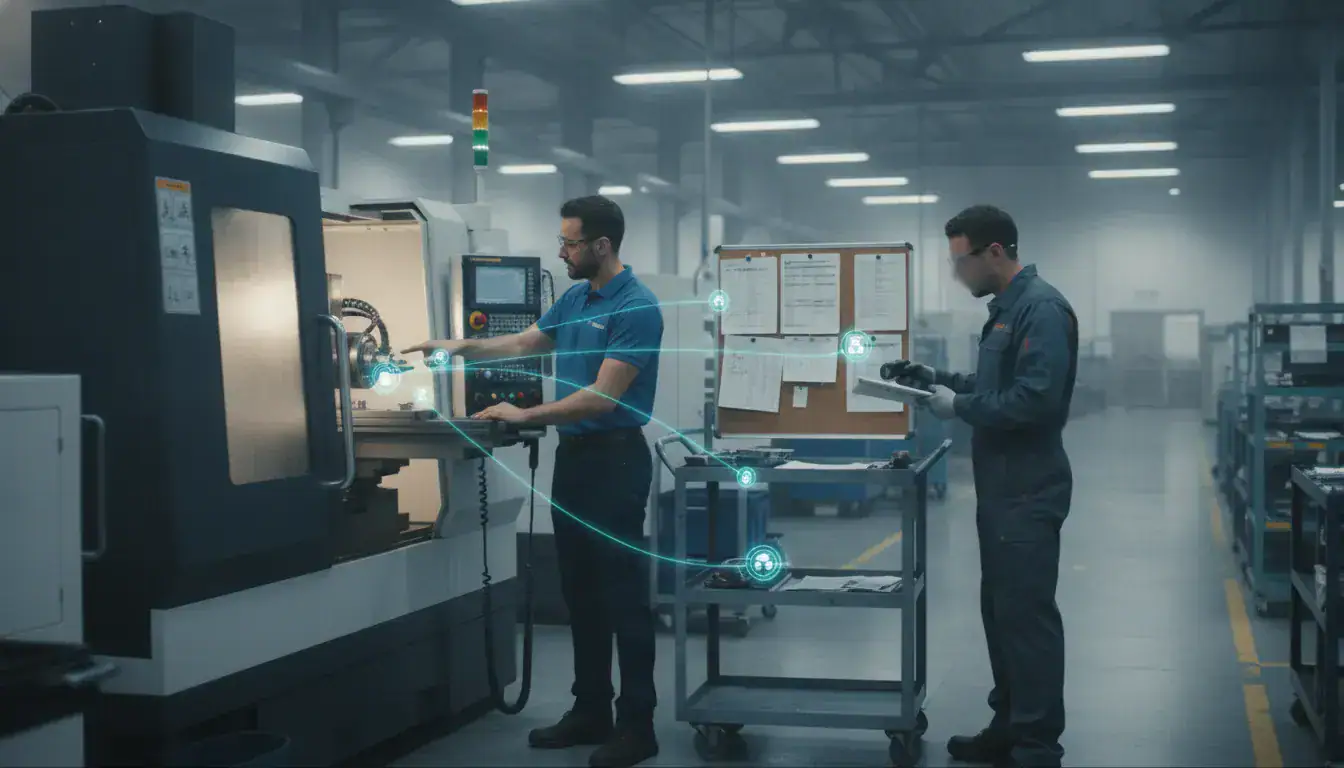

Every minute of machine downtime, every scrapped part, and every late delivery costs you money. While manual tracking might feel sufficient, it often hides the true cost of inefficiency. A Manufacturing Execution System (MES) is an investment in your profitability, designed to give you the real-time data needed to reduce waste and improve throughput. Before you commit, it’s crucial to understand the potential return. This guide will show you how to evaluate the financial impact, what features deliver the most value, and provide a list of MES software to help you find a solution that pays for itself.
Key Takeaways
- Define Your “Why” Before You Buy: An MES should be a solution to your specific shop floor headaches, not just another piece of software. Identify your biggest challenges, like production delays or high scrap rates, and choose a system that provides the real-time data you need to solve them.
- Evaluate for Fit, Not Just Features: The right MES feels like a natural extension of your team. Compare your options by focusing on key areas: its fit for your industry, the total cost (including hidden fees), its ability to integrate with your ERP, and its potential to scale with your business.
- Plan for People to Ensure Success: The best technology is useless if your team won’t use it. Prevent common implementation issues by involving your team in the selection process, planning for thorough training, and choosing an intuitive system that makes their jobs easier, not harder.
What Is MES Software (and Do You Actually Need It)?
Let’s start by demystifying the acronym. MES stands for Manufacturing Execution System, and you can think of it as the central nervous system for your factory floor. It’s a type of software that monitors, controls, and documents the entire manufacturing process, from raw materials to finished goods, in real time. Essentially, an MES acts as a critical bridge between your high-level business planning in an ERP system and the actual work happening on your machines. It translates orders into production tasks and sends real-time performance data back up the chain.
So, how do you know if you actually need one? If your team spends more time chasing down paperwork and updating spreadsheets than managing production, it’s a strong sign. Or maybe you’re struggling with production delays and can’t pinpoint the exact cause until it’s too late. These are common growing pains that manual systems just can’t solve. In fact, some research shows teams can spend up to 30% of their time on manual paperwork alone, which is a huge drain on productivity.
This is where an MES comes in. By automating shop floor data collection, it gives you a live, accurate view of your operations. You can see what’s working, where bottlenecks are forming, and how to adjust your production scheduling on the fly. Instead of guessing, you get the data you need to make informed decisions that improve efficiency, maintain quality, and ensure you deliver on time. The right system doesn’t just add another layer of software; it provides a clear return on investment by solving specific operational headaches.
How to Compare MES Solutions
Choosing a Manufacturing Execution System is a major decision, and with so many options on the market, it’s easy to feel overwhelmed. Think of this process less like buying software and more like finding a strategic partner for your shop floor. A great MES should feel like an extension of your team, giving you the visibility and control you need to hit your production goals. To cut through the marketing noise and find the right fit, focus on four key areas: the features it offers, its fit for your industry, the total cost, and how well it will connect with the systems you already use. Breaking down your evaluation this way will help you compare your options clearly and confidently.
Features and Functionality
At its core, an MES helps you manage, track, and control everything happening on your factory floor in real time. But not all systems are created equal. Some offer basic tracking, while others provide a comprehensive suite of tools for everything from production scheduling to quality control. Before you even look at vendors, sit down with your team and make a list of your must-have features. What are the biggest bottlenecks you need to solve right now? Do you need real-time machine monitoring or advanced shop floor data collection? Knowing your priorities will prevent you from being distracted by flashy features you’ll never use.
Industry Focus and Scalability
Some MES platforms are designed for specific industries, like pharmaceuticals or aerospace, with built-in features to meet strict regulatory requirements. Others are more flexible and can adapt to a wide range of manufacturing processes. Consider whether you need a specialized system or a more adaptable one that can be configured to your unique workflow. More importantly, think about your future. Will this software scale with you as you add new machines, production lines, or even a second facility? The right system should support your growth, not hold you back. Make sure any potential partner can show you a clear path for how their solution will grow alongside your business.
Pricing and Total Cost of Ownership
MES pricing can be complex, varying based on your factory’s size, the number of users, and the features you need. While it’s tempting to focus on the initial price tag, it’s crucial to consider the total cost of ownership. This includes one-time implementation fees, training costs, and ongoing subscription or support charges. A lower-priced system might have hidden costs or require expensive customizations down the line. The goal is to find a solution that delivers a strong return on investment by improving efficiency and reducing waste. The best way to understand the full cost is to request a demo and get a detailed quote tailored to your operation.
Ease of Integration
Your MES won’t operate in a vacuum. It needs to communicate seamlessly with your other business systems, especially your Enterprise Resource Planning (ERP) software. A well-integrated system ensures that data flows smoothly from the front office to the shop floor and back, eliminating manual data entry and providing a single source of truth for your entire operation. When talking to vendors, ask detailed questions about their integration capabilities. A system that doesn’t connect easily with your existing technology will only create more work and data silos, which is exactly what you’re trying to avoid. The right partner will have a clear process for making these connections work.
A Guide to the Top MES Software
Choosing the right MES feels like a huge decision, because it is. The software you pick will become the digital backbone of your shop floor. To help you sort through the options, I’ve put together a list of ten leading MES solutions. Each one has its own strengths and is often tailored for specific types of manufacturing. Think of this as your starting point for finding the perfect fit for your team, your processes, and your business goals. Let’s look at what makes each of these platforms unique.
1. JobPack
JobPack is a powerful MES solution built specifically for manufacturers who need to get control of their shop floor and deliver work on time. Its strength lies in its highly visual and intuitive interface, which makes complex scheduling simple. The system provides real-time job tracking, reporting, and production scheduling that helps you see bottlenecks before they become problems. It’s designed to improve operational efficiency by connecting directly to your machines for accurate data collection. This gives you the insight-rich analytics needed to reduce waste and stick to your budget, making it a great choice for shops that want a practical, results-driven system without a steep learning curve.
2. Siemens Opcenter
Coming from a global leader in industrial automation, Siemens Opcenter is a comprehensive suite of Manufacturing Operations Management (MOM) applications. This platform goes beyond a traditional MES by integrating production planning, scheduling, quality management, and manufacturing execution into a single ecosystem. It’s designed to give large-scale manufacturers complete visibility and control over their global operations. If your business requires a robust, all-in-one solution that can manage complex processes and connect with a wide range of enterprise systems, Siemens Opcenter provides the depth and breadth to handle demanding production environments.
3. Rockwell Automation FactoryTalk
Rockwell Automation is another giant in the industrial world, and its FactoryTalk software suite is built to connect and manage your entire manufacturing operation. Its key advantage is its seamless integration with Rockwell’s own automation hardware, like Allen-Bradley PLCs. This creates a tightly connected environment from the machine level all the way up to the enterprise level. The FactoryTalk platform offers a strong set of tools for data collection, real-time visualization, and performance analysis. It’s an excellent option for manufacturers who already use Rockwell hardware and want a unified software layer to make data-driven decisions.
4. Critical Manufacturing
As the name suggests, Critical Manufacturing MES is tailored for high-tech, complex industries like semiconductor, electronics, and medical device manufacturing. These fields have incredibly strict requirements for traceability, quality, and process control, and this MES is built to handle that complexity. It emphasizes flexibility and scalability, featuring a modern, modular architecture that can adapt to rapidly changing production environments and new technologies. If you operate in a highly regulated or technologically advanced industry where precision is non-negotiable, Critical Manufacturing MES provides the advanced capabilities needed to maintain compliance and a competitive edge.
5. Tulip
Tulip offers a fresh, human-centric approach to manufacturing software. It’s a user-friendly, no-code platform that empowers the people on your shop floor to create their own applications and digital workflows without writing a single line of code. This flexibility allows for rapid deployment and customization, making it accessible for manufacturers of all sizes who want to digitize their processes quickly. Tulip focuses on giving workers the interactive tools they need to improve productivity, reduce errors, and capture real-time data directly from their workstations. It’s a fantastic choice for companies looking for an agile, bottom-up approach to operational improvement.
6. Epicor Advanced MES
For manufacturers already using or considering Epicor’s ERP system, the Epicor Advanced MES is a natural fit. This solution is designed for deep integration with their ERP platform, creating a single, unified source of truth from the top floor to the shop floor. It provides real-time insights into every aspect of the production process, from machine performance to labor tracking. The system helps you identify inefficiencies, reduce scrap and waste, and improve overall productivity. If you value a seamless connection between your business and production systems, Epicor Advanced MES offers a comprehensive and integrated solution.
7. Parsec Trackwise Manufacturing
Parsec Trackwise Manufacturing is designed to provide real-time visibility and control over manufacturing operations. It focuses on improving quality and compliance while optimizing production efficiency. Its core strength is in performance management, helping you measure and improve key metrics across one or more plants. Parsec’s platform is particularly effective for manufacturers in industries like food and beverage or consumer packaged goods, where improving quality and ensuring compliance are top priorities.
8. Aegis FactoryLogix
Aegis FactoryLogix stands out with its comprehensive, modular approach to manufacturing operations management. This allows you to implement the specific MES capabilities you need right now, such as production tracking or quality management, and add more modules as your business grows and your needs evolve. This prevents you from being locked into a monolithic system with features you don’t use. Aegis FactoryLogix is particularly strong in the electronics assembly industry, offering deep functionality for everything from new product introductions to real-time monitoring and traceability. It’s a great option for manufacturers who want a powerful, scalable platform they can grow into over time.
9. Plex Manufacturing Cloud
Plex is a pioneer in cloud-based manufacturing software, offering a solution that was born in the cloud. The Plex Manufacturing Cloud is a single, integrated platform that combines MES, ERP, and supply chain management capabilities. Because it’s cloud-native, it reduces your IT overhead, eliminates the need for on-site servers, and provides secure access from anywhere. This integrated approach ensures seamless data flow across your entire business, from quoting and ordering to production and shipping. For manufacturers looking to simplify their tech stack and adopt a modern, scalable platform, Plex offers a compelling all-in-one solution.
10. Infor CloudSuite Industrial
Infor is another major player in the ERP space, and its CloudSuite Industrial is designed for manufacturers who want to use cloud technology to run their operations. The platform includes a robust set of MES capabilities, such as production planning, detailed scheduling, and quality management, all tightly integrated within a broader ERP framework. It’s built to handle the specific needs of discrete and industrial manufacturers, offering industry-specific functionality right out of the box. For businesses looking for a comprehensive, cloud-based solution from a single, established vendor, Infor CloudSuite Industrial provides a powerful and scalable option.
What Key Features Should You Look for in MES Software?
When you start comparing MES solutions, you’ll quickly realize they aren’t all built the same. The sheer number of features can feel overwhelming, but you can simplify your search by focusing on a few core capabilities that deliver the most impact. Think of it as a checklist for your shop’s future success. The right MES software should give you a clear, real-time view of your entire operation, from the moment an order comes in to the second it ships out the door. It’s about connecting your people, machines, and processes into one cohesive system that works for everyone, not against them.
A great MES doesn’t just collect data; it helps you use that data to make smarter, faster decisions. It should help you schedule jobs more effectively, manage resources without guesswork, and maintain quality standards with every part you produce. The goal is to move from constantly putting out fires to proactively managing your production flow, which ultimately improves your bottom line and reduces stress for your team. The features below are the building blocks of a modern, efficient manufacturing environment. As you evaluate your options, make sure any potential system checks these essential boxes to support your long-term growth and operational excellence.
Real-Time Monitoring and Shop Floor Data Collection
The foundation of any good MES is its ability to show you what’s happening on your shop floor right now. Real-time monitoring means you’re no longer relying on yesterday’s reports to solve today’s problems. This feature connects directly to your machines and operator stations to track job progress, cycle times, and machine status live. Paired with effective shop floor data collection, it replaces manual tracking and guesswork with hard facts. This immediate feedback loop allows your team to spot bottlenecks, address downtime instantly, and keep production moving smoothly, ensuring you have an accurate, up-to-the-minute picture of your operations.
Production Scheduling and Resource Management
A powerful MES transforms your scheduling from a static plan into a dynamic, responsive tool. Instead of creating a schedule and just hoping for the best, you can optimize your entire workflow. This feature helps you manage all your resources, including machines, tools, and labor, to ensure everything is in the right place at the right time. When unexpected issues arise, like a machine going down or a priority order coming in, a dynamic production scheduling system allows you to adjust on the fly with drag-and-drop simplicity. This capability is crucial for improving on-time delivery rates, reducing lead times, and making the most of your shop’s capacity.
Quality Management and Traceability
Maintaining consistent quality is non-negotiable, and a good MES builds quality control directly into your production process. This includes providing operators with clear, digital work instructions and checklists at their stations to minimize errors and ensure every step is followed correctly. It also provides complete traceability, creating a detailed digital record for every part and assembly. This means you can track a product’s entire journey, from the raw materials used to the final inspection. This level of tracking is essential for meeting industry regulations, quickly addressing any quality issues, and giving you and your customers confidence in your products.
Analytics, Reporting, and ERP Integration
Collecting data is one thing, but turning it into actionable insight is where the real value lies. Your MES should come with powerful data analytics tools that make it easy to understand your performance. Look for intuitive dashboards and customizable reports that track key metrics like Overall Equipment Effectiveness (OEE), scrap rates, and cycle times. Equally important is the software’s ability to integrate seamlessly with your existing Enterprise Resource Planning (ERP) system. This connection creates a single, unified view of your business, ensuring that data from the shop floor informs financial and operational decisions in the front office, and vice versa.
Mobile Access and User-Friendliness
The most powerful software in the world is useless if your team won’t use it. A modern MES should have a clean, intuitive interface that’s easy for everyone to learn, from machine operators to plant managers. Complicated screens and confusing workflows can kill adoption rates. Look for a system that feels straightforward and presents information clearly. Furthermore, consider whether the software offers mobile access on tablets or phones. This allows supervisors to monitor production, operators to log data, and managers to check job statuses while walking the floor, untethering them from a fixed workstation and making the system a more integrated part of their daily routine.
How Do MES Solutions Compare by Industry?
Not all MES platforms are built the same, and the right one for you often comes down to your specific industry. A system that works wonders for a food and beverage plant might be a poor fit for an aerospace components manufacturer. Understanding these differences is the first step to narrowing your search and avoiding a solution that isn’t designed for your unique challenges. Some MES solutions are generalists, but many are highly specialized.
Generally, we can group MES software by its suitability for three main categories: discrete manufacturing, process manufacturing, and highly regulated industries. Each has distinct production models and operational priorities, which means they require different features from their MES. For example, a discrete manufacturer might prioritize real-time machine monitoring to reduce downtime, while a pharmaceutical company will focus on batch traceability to meet FDA requirements. Knowing where your operation fits will help you filter out the noise and focus on the software that can truly support your goals. JobPack, for instance, is a highly adaptable system that excels in the complex, high-mix environments common in discrete manufacturing.
Discrete Manufacturing
If you make distinct, countable items like automotive parts, electronics, or industrial machinery, you’re in discrete manufacturing. The main goal here is usually to improve production efficiency, manage complex multi-level assemblies, and maintain high product quality. MES software for this sector is all about visibility and control over individual units, work orders, and production lines.
The right MES helps you track a part from raw material to finished product, manage your bill of materials (BOM), and optimize workflows on the shop floor. According to ABI Research, choosing the right MES is crucial for discrete manufacturers to run their operations more effectively. Solutions like JobPack are designed for this environment, providing powerful production scheduling and shop floor data collection to give you a clear, real-time view of every job. This allows you to spot bottlenecks, reduce setup times, and ensure every order is on track.
Process Manufacturing
Process manufacturing involves mixing ingredients or raw materials using formulas or recipes. Think of industries like food and beverage, chemicals, or plastics. Unlike discrete manufacturing where you can take a product apart, here the process is continuous or batch-based, and the final product can’t be disassembled into its original components.
MES solutions for process manufacturers focus on different priorities. They need to manage recipes, ensure batch consistency, and track yields. For these businesses, features like batch management, formula control, and quality analysis are essential. For example, a system like Honeywell MXP is designed for process industries by combining MES with other functionalities to manage continuous production flows. The key is ensuring every batch meets the exact same specifications, and the MES is central to maintaining that consistency and quality.
Regulated Industries (Pharma, Aerospace, and Defense)
While pharmaceuticals can be a process industry and aerospace is discrete, they share a common, overarching challenge: intense regulatory oversight. In these fields, compliance isn’t just a goal; it’s a requirement for doing business. An MES for a regulated industry must have robust features for traceability, documentation, and quality management to meet strict standards from bodies like the FDA or FAA.
For example, a system like Werum PAS-X is tailored for pharma and biotech, with a heavy focus on managing electronic batch records and meeting GMP (Good Manufacturing Practices) guidelines. Similarly, iBASE-t Solumina is built for the complex needs of aerospace and defense, where every component must be traceable and documented. These specialized systems provide detailed audit trails and enforce quality checks at every step, ensuring nothing falls through the cracks.
What Does MES Software Actually Cost?
Figuring out the price tag for a Manufacturing Execution System isn’t as simple as looking up a number online. The final cost depends heavily on your specific operation: the size of your shop, the complexity of your processes, the number of users, and the exact features you need. A basic system for a small shop might be a relatively modest investment, while a comprehensive solution for a large, multi-facility operation can be a significant capital expense.
The key is to look beyond the initial quote and understand the total cost of ownership. This includes not just the software license itself, but also implementation, training, and ongoing support. Thinking about the full picture will help you budget accurately and find a solution that delivers real value without any financial surprises down the road.
Subscription vs. Perpetual License Models
When you start looking at pricing, you’ll generally find two models: perpetual and subscription. A perpetual license is the traditional approach where you pay a large, one-time fee to own the software indefinitely. This is a capital expense, and it often comes with a separate, recurring annual fee for maintenance and support.
The more modern approach is a subscription model, often called Software-as-a-Service (SaaS). With this, you pay a recurring monthly or annual fee, which typically includes the software license, support, and all future updates. This turns the cost into a predictable operating expense. The right choice depends on your company’s financial strategy, but understanding both options is the first step in comparing what different MES providers offer.
Hidden Costs to Watch For
The sticker price of an MES is rarely the final price. To avoid getting caught off guard, you need to ask about the other costs involved in getting the system up and running. Implementation and integration fees, for example, cover the technical work of installing the software and connecting it to your existing ERP and machinery. If you need the software tailored to your unique workflows, you’ll also want to budget for customization.
Don’t forget the human element. Employee training is essential for successful adoption, and it represents an investment of both time and money. Finally, ask about ongoing support and maintenance fees, especially with perpetual licenses. A good time to clarify all of these potential costs is during a product demo, where you can get a full breakdown of the total investment.
How to Calculate ROI Before You Commit
An MES is only a good investment if it solves real problems on your shop floor. Before you commit, you need to calculate its potential return on investment (ROI). Start by identifying your biggest pain points. Are you struggling with machine downtime, high scrap rates, or late deliveries? Put a number to those problems. Calculate how much money you lose each month to inefficiency or waste.
From there, you can estimate the savings an MES could generate. For instance, how much could you save by reducing downtime by 15% or improving on-time delivery rates by 20%? A solid MES provider should be able to help you build this business case, often by sharing case studies from similar companies. This calculation turns the cost of an MES from an expense into a strategic investment in your shop’s profitability and growth.
Common MES Implementation Challenges (and How to Avoid Them)
Bringing a Manufacturing Execution System into your shop is a big step, and like any major project, it can have its hurdles. But don’t let that scare you. Most implementation headaches can be avoided with some foresight and planning. By thinking through these common challenges ahead of time, you can set your team up for a smooth transition and start seeing results faster. Let’s walk through the four biggest sticking points and how you can get ahead of them.
Define Your Requirements Before You Buy
It’s easy to get wowed by a demo showing off dozens of features, but the best MES isn’t the one with the most bells and whistles; it’s the one that solves your specific problems. Before you even look at vendors, take time to understand your own operational pain points. Are you struggling with on-time delivery? Is scrap eating into your profits? Do you lack visibility into machine downtime? As one manufacturer put it, “It’s important to understand your problems first, rather than just looking for a system with many features.” Create a clear list of your “must-have” functions and goals. This simple step will help you cut through the noise and find a partner who understands why you need a solution in the first place.
Plan for ERP and Legacy System Integration
An MES acts as the central nervous system for your shop floor, connecting your business-level planning in the ERP with the real-time activity happening at each machine. A successful implementation hinges on how well these systems talk to each other. Before you sign a contract, ask detailed questions about integration. Does the MES have a proven track record of connecting with your specific ERP? How does it handle data from older, legacy equipment? A vendor should be able to clearly explain their integration process and how their system will centralize information for powerful data analytics. Don’t let integration be an afterthought; make it a key part of your evaluation.
Prepare for Employee Training and Adoption
The most powerful software in the world is useless if your team doesn’t use it. Getting your operators and managers on board is one of the most critical parts of any MES implementation. Start by involving them in the selection process to build early buy-in. Look for a system with a clean, intuitive interface, because as one operator noted, “A simple, clear system helps workers learn it quickly.” Ensure your chosen vendor provides thorough training and ongoing support. A smooth adoption process empowers your team to use the new tools effectively from day one, as many successful shops have shown in their own case studies.
Avoid the Over-Customization Trap
While your operation is unique, you should be wary of any MES that requires extensive, ground-up customization. This approach can lead to a system that is expensive, difficult to maintain, and nearly impossible to upgrade down the line. Many MES solutions were originally designed for a specific industry, so it’s wise to find one that already aligns with your type of manufacturing. A better strategy is to find a flexible system that meets 80% of your needs out of the box and can be easily configured for the rest. Focus on strong core functionalities like production scheduling and data collection, and choose a solution built for adaptability, not endless custom coding.
Which MES Software Is Right for Your Operation?
Choosing the right MES feels like a huge decision, because it is. This software will become the digital backbone of your shop floor, so you want to get it right. Instead of getting overwhelmed by features, focus on what your operation truly needs. By asking the right questions upfront, you can find a system that fits your team, your budget, and your long-term goals.
Here are a few key things to consider:
-
Know your industry needs. Some MES solutions are built for very specific fields, like pharmaceuticals or high-tech electronics. Others are designed for the complex demands of discrete manufacturing. Make sure any system you consider understands the unique challenges of your industry, from compliance to production methods.
-
Think about integration. Your MES can’t live on an island. It needs to communicate seamlessly with your existing ERP and other business systems. A system that offers smooth data analytics and integration prevents information silos and ensures everyone is working from the same playbook.
-
Plan for growth. The system that works for you today should also work for you in five years. Ask potential vendors how their software scales. Can it grow from a single production line to multiple sites? You’re not just buying software; you’re investing in a platform that should support your future ambitions.
-
Prioritize your people. The most powerful software is useless if your team finds it clunky or confusing. Look for an intuitive, user-friendly interface. The best way to gauge this is to request a demo and get your team’s feedback. Also, check on the vendor’s support. You want a partner who will be there to help when you need it.
-
Start with your problems. Before you even look at pricing, identify the biggest headaches you’re trying to solve. Is it inventory errors? Late deliveries? Quality control? A good MES should offer a clear return on investment by directly addressing these pain points. Seeing how other companies solved similar problems in case studies can give you a good idea of the potential ROI.
Related Articles
- MES System for Manufacturing: The Ultimate Guide
- What is MES System Software? A 2026 Guide
- What is a Manufacturing Execution System (MES)?
- Gartner Magic Quadrant for MES: A Complete Guide
Frequently Asked Questions
We already use an ERP system. Isn’t an MES just redundant? That’s a common question, but they actually perform very different jobs. Think of your ERP as the front office; it manages business-level functions like accounting, customer orders, and purchasing. An MES, on the other hand, is the shop floor manager. It takes the orders from the ERP and translates them into real-time, actionable tasks for your machines and operators, then sends performance data back. Instead of being redundant, a good MES makes your ERP more powerful by connecting your business plan to your production reality.
What’s the most immediate benefit we can expect after implementing an MES? The most significant and immediate change is clarity. You will move from managing your shop with day-old reports to seeing exactly what is happening on the floor in real time. You’ll know instantly when a machine goes down, if a job is running slower than planned, or where a bottleneck is forming. This visibility allows your team to stop firefighting and start proactively solving small problems before they become big, expensive ones.
How does an MES help my team on the shop floor? Is it just more work for them? A well-designed MES should actually make life easier for your operators. It replaces paper travelers and manual data entry with clear, digital work instructions and simple data collection at their station. This means they spend less time on paperwork and more time on the skilled work they were hired to do. It empowers them with the information they need to meet quality standards and production goals, turning them into more engaged and effective members of the team.
Our manufacturing process is unique. Can a standard MES really fit our needs? Your operation is definitely unique, and you should be cautious of any software that claims to be a perfect fit for everyone right out of the box. The key is to find a system that is highly configurable rather than one that requires extensive custom coding. A flexible MES can be adapted to your specific workflows and terminology, giving you a tailored solution without the high cost and maintenance headaches of a fully custom-built system.
Will implementing an MES disrupt our current operations? This is a major concern for any busy shop, and a good implementation partner will make minimizing disruption their top priority. The process is typically planned in phases to ensure a smooth transition, often starting with a single area or machine group. While any new system has a learning curve, the goal is to quickly replace the daily disruptions of manual tracking and production delays with a more stable, predictable, and efficient operation.