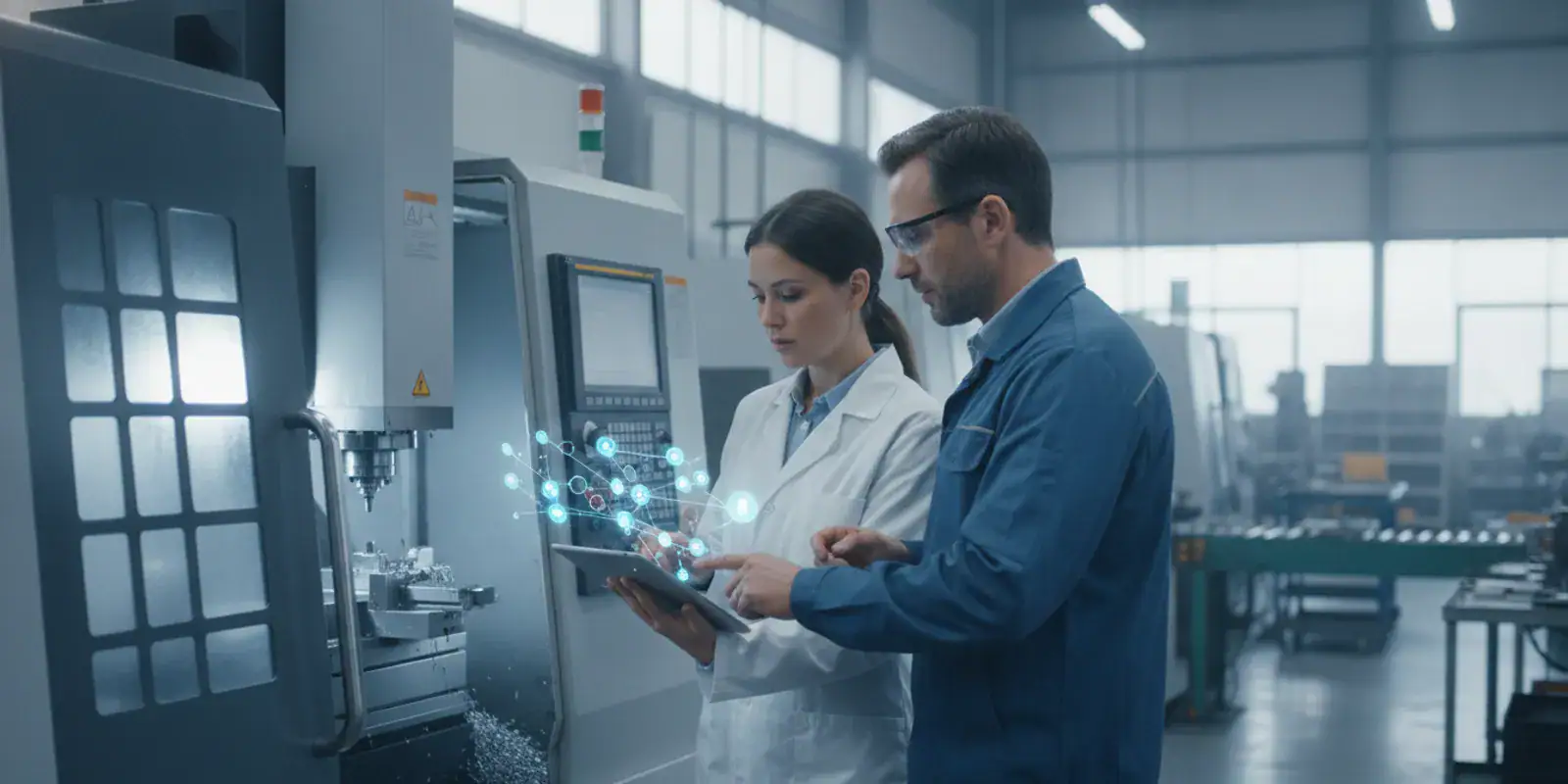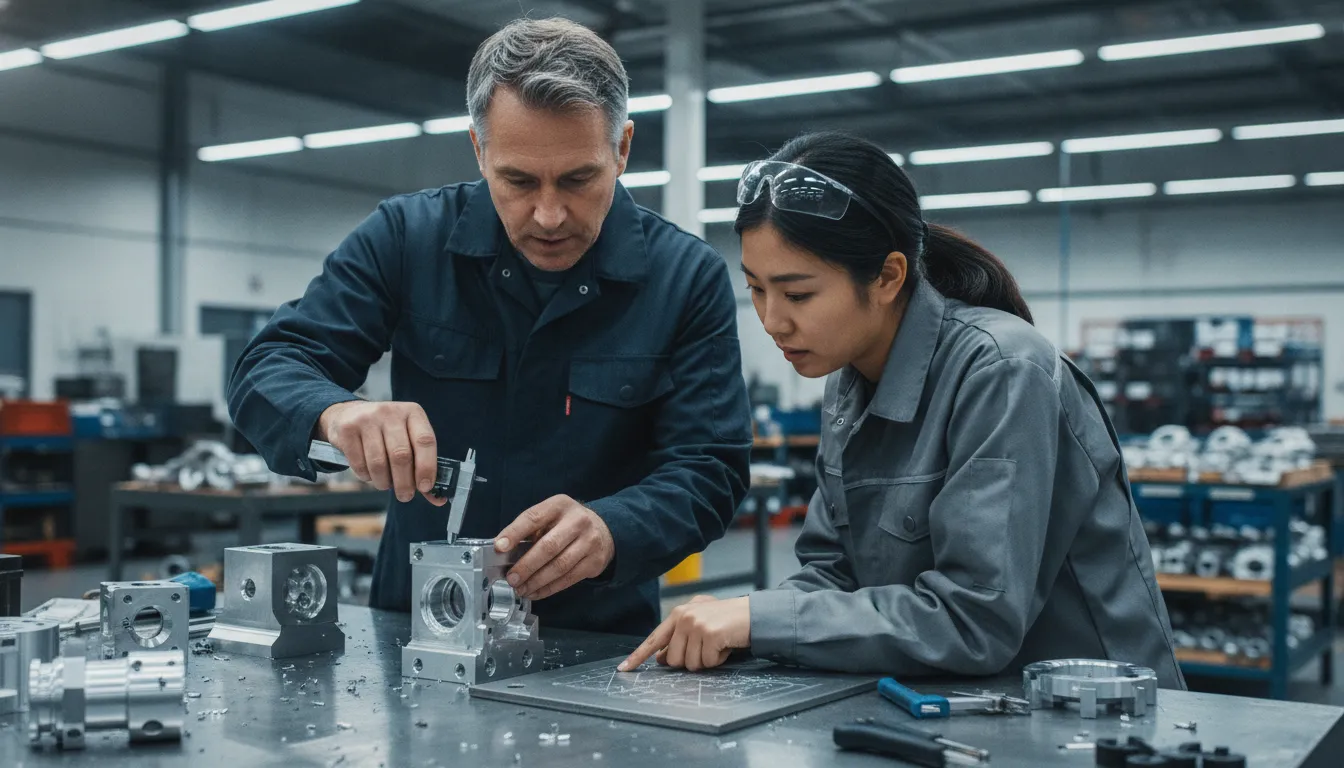
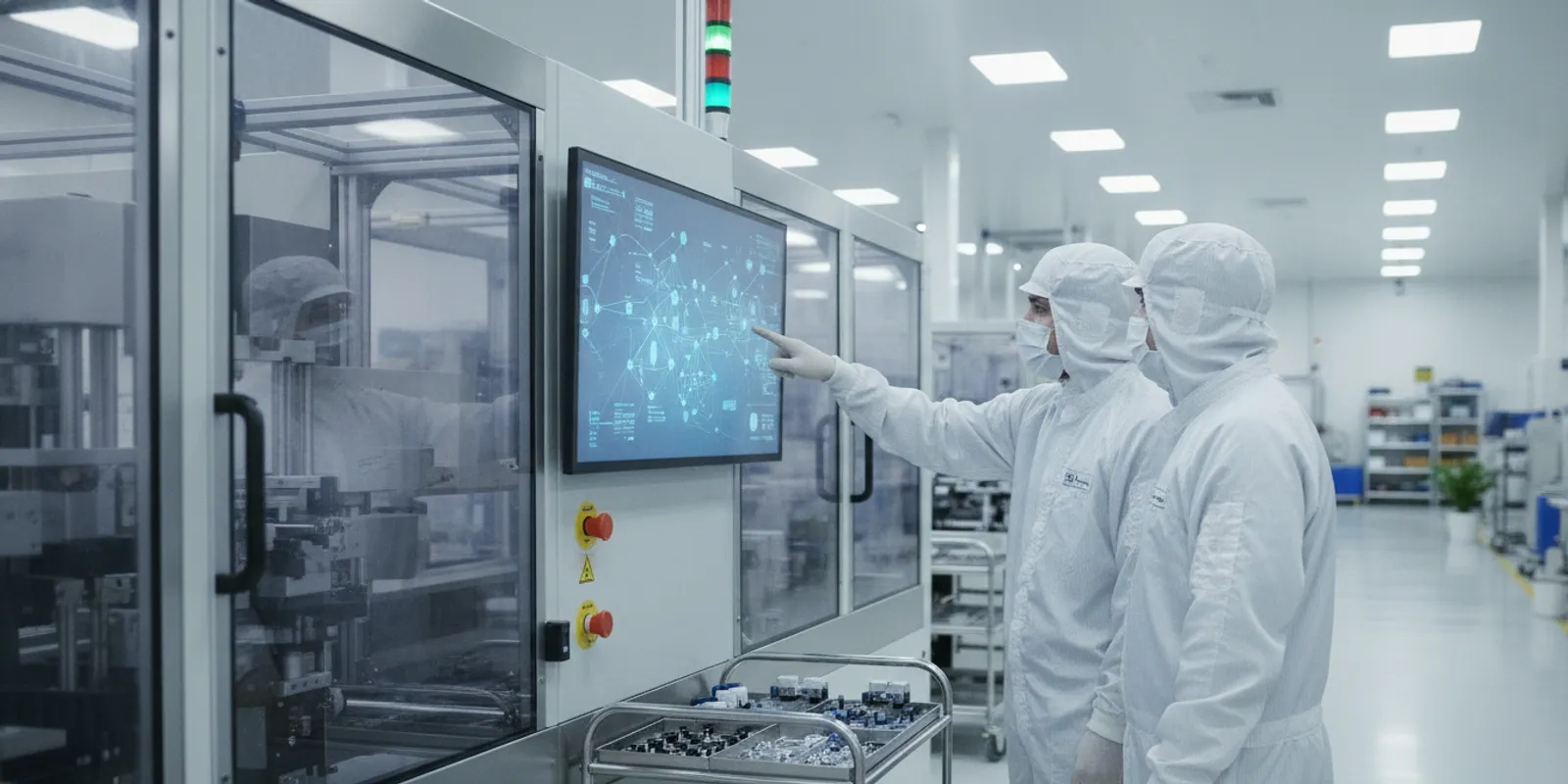
What is advanced manufacturing? It is the use of new or improved processes, equipment, materials, and information systems to make products more efficiently, precisely, flexibly, and sustainably. For a discrete manufacturer, that can mean a connected CNC workcell, additive manufacturing, robotics, in-process inspection, or a better way to turn shop-floor data into reliable production decisions.
What is advanced manufacturing?
Advanced manufacturing is an umbrella term for manufacturing methods that improve how products are designed, made, measured, and managed. It includes advances to individual processes, machines, production systems, materials, and workforce practices. The category is defined by the practical improvement being made, not by a single machine, software package, or level of automation.
The National Institute of Standards and Technology describes manufacturing-related research and development across unit processes, machine technologies, systems technologies, and environmental or societal technologies. That broad view is useful for plant leaders because it keeps the focus on the whole production system rather than on a technology trend in isolation. NIST’s manufacturing technology definition provides additional context.
How is advanced manufacturing different from Industry 4.0 and digital manufacturing?
Advanced manufacturing, Industry 4.0, and digital manufacturing overlap, but they are not interchangeable. Advanced manufacturing includes physical processes, materials, machines, workforce practices, and information systems. Industry 4.0 emphasizes connected, data-driven production. Digital manufacturing focuses on the digital tools and data flows that support design, planning, execution, and improvement.
| Term | Primary focus | Example in a discrete plant |
|---|---|---|
| Advanced manufacturing | Improving the way products and processes are made | Using additive manufacturing, advanced inspection, or a new machining process to improve capability |
| Industry 4.0 | Connecting machines, people, and systems for smarter decisions | Collecting machine status and production events in real time |
| Digital manufacturing | Using digital models, software, and data across the manufacturing lifecycle | Linking ERP orders, routings, schedules, work instructions, and actual production results |
| MES | Managing and tracking production execution | Recording work-in-process, labor, machine activity, quality events, and completion status |
In practice, a plant may use all four concepts at once. A new robotic workcell is an advanced manufacturing investment. Connecting that cell to a monitoring system supports Industry 4.0. Using a digital production schedule to coordinate it is digital manufacturing. Capturing actual output and downtime is part of manufacturing execution. The value comes from making those pieces work together.
JobPack’s Industry 4.0 manufacturing guide covers the connected-data side of this broader topic. This article focuses on the larger definition and on how manufacturers can evaluate advanced manufacturing as an operating model.
What technologies are used in advanced manufacturing?
Advanced manufacturing technologies improve one or more parts of the production system: process capability, repeatability, flexibility, visibility, speed, quality, or resource efficiency. The right mix depends on the products, routings, machines, workforce, regulatory requirements, and business constraints of the plant.
- Additive manufacturing: Producing parts layer by layer for prototypes, complex geometries, tooling, fixtures, or selected production applications.
- Advanced subtractive manufacturing: Using high-capability CNC equipment, automation, improved tooling, and process controls to produce precise parts consistently.
- Robotics and automation: Automating material handling, machine tending, assembly, inspection, packaging, or repetitive motions while keeping people responsible for supervision and exception handling.
- Industrial connectivity: Connecting machines and production assets through standards and interfaces such as MTConnect, OPC UA, Ethernet, or equipment-specific protocols.
- Industrial Internet of Things and sensors: Capturing machine states, cycle information, energy use, vibration, temperature, quality measurements, and other production signals.
- Artificial intelligence and machine learning: Finding patterns in production or quality data, supporting forecasting, detecting anomalies, or helping teams prioritize attention. AI is useful when the underlying data and process are reliable.
- Digital twins and simulation: Representing a machine, workcell, process, or facility digitally to test scenarios, understand behavior, and improve decisions before changing the physical operation. NIST’s digital twin work highlights the importance of interoperability, validation, and trustworthy data.
- Advanced materials and process technologies: Using improved materials, coatings, composites, forming methods, joining methods, or specialized process controls to create products with new or better performance.
- Integrated manufacturing software: Connecting ERP, production scheduling, machine monitoring, shop-floor data collection, quality information, and analytics so teams can act on current production conditions.
Technology selection should follow a production problem, not the other way around. A plant with late orders may gain more from finite-capacity scheduling and accurate machine status than from adding another disconnected dashboard. A plant with inconsistent cycle times may need process control and data capture before it needs predictive analytics.
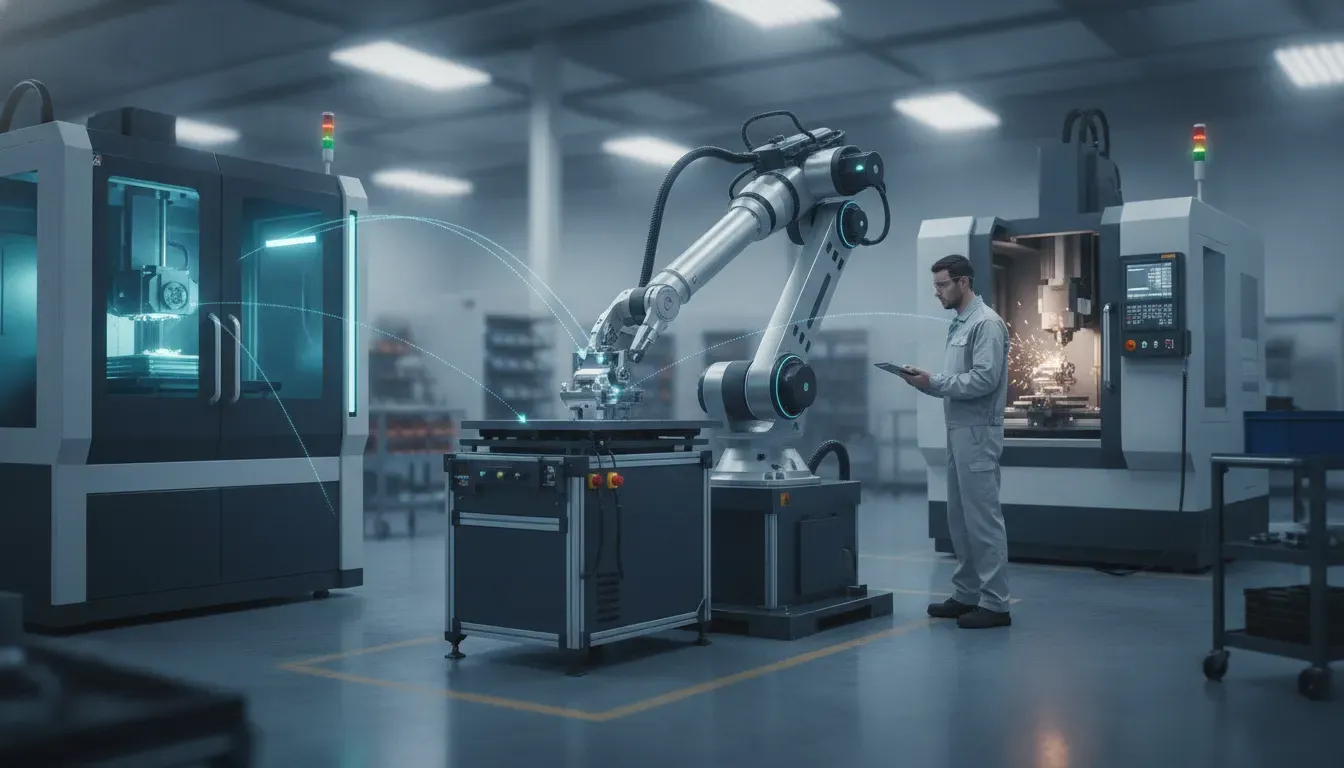
What are examples of advanced manufacturing?
Examples of advanced manufacturing range from a single improved process to a connected production network. A project qualifies because it improves manufacturing capability or control, not simply because it uses a newer device. The strongest examples tie technology to a measurable production, quality, delivery, safety, or resource outcome.
Connected CNC machining
A job shop can connect CNC machines to collect running, idle, alarm, and downtime events. Supervisors gain a current view of machine activity, while production planners can compare planned work with actual conditions. The result is a more responsive operation, especially when the shop has high mix, changing priorities, or outside processing.
Robotic machine tending
A robot can load and unload parts while an operator manages setup, inspection, replenishment, and exceptions. The improvement is not only labor efficiency. It can also create more consistent handoffs, extend unattended production windows, and provide a repeatable process for a high-volume or repetitive operation.
Additive manufacturing for tooling or production parts
A manufacturer may use additive manufacturing to create a complex prototype, a lightweight component, a conformal-cooling tool, or a production part that is difficult to make conventionally. The business case should account for material properties, post-processing, inspection, repeatability, and how the new process fits the existing routing.
In-process inspection and quality feedback
Probes, machine vision, coordinate measurement, and other inspection methods can detect variation closer to the point where it occurs. When quality results are connected to jobs, operations, tools, or machines, teams can identify patterns instead of treating every nonconformance as an isolated event.
Digitally coordinated production
A plant can use an integrated production schedule, digital work queues, machine status, and shop-floor confirmations to replace disconnected spreadsheets and paper updates. This is an important advanced manufacturing example because it improves the system around the machines. Better decisions about sequence, capacity, and delivery can increase the value of existing equipment.
JobPack supports this operational layer through visual production scheduling, real-time machine monitoring, manufacturing data analytics, and shop-floor data collection. These capabilities do not replace the physical technologies above. They help manufacturers coordinate, measure, and improve the work those technologies perform.
What are the benefits of advanced manufacturing?
Advanced manufacturing can help a plant improve performance when the selected technology is tied to a clear constraint. Potential benefits include greater process consistency, faster response to changes, better visibility into capacity, improved quality feedback, lower waste, stronger worker safety, and more reliable delivery commitments.
- More predictable production: Current machine and job information helps teams identify risk before a promised date is missed.
- Higher utilization: Visibility into running, idle, and unavailable equipment can reveal hidden capacity and recurring losses.
- Better quality control: Connected process and inspection data can shorten the path from variation to corrective action.
- Greater flexibility: Digital planning, automation, and adaptable processes help plants respond to product mix and demand changes.
- Lower waste and rework: Better process control and earlier issue detection can reduce scrap, avoidable movement, and repeated work.
- Improved workforce support: Digital work instructions, clear priorities, and automation can reduce dependence on undocumented tribal knowledge.
- Stronger business decisions: Reliable production data gives operations, finance, sales, and leadership a shared view of what the plant can deliver.
These are opportunities, not automatic outcomes. A connected machine can produce more data without improving decisions. Automation can move a bottleneck upstream or downstream. A digital twin can be difficult to trust if its inputs are incomplete. Advanced manufacturing pays off when process ownership, data quality, maintenance, training, and measurement are planned alongside the technology.
Talk with JobPack about connecting production data to better scheduling decisions
How should a manufacturer implement advanced manufacturing?
Manufacturers should implement advanced manufacturing in stages, beginning with a specific production problem and a measurable baseline. Start with the process, data, and people involved, then select the smallest technology investment that can test the improvement. Scale only after the plant can operate, maintain, and measure the new process.
- Define the business constraint. Choose a problem such as late orders, excess setup time, recurring downtime, inconsistent quality, or limited capacity visibility. Avoid starting with a technology label.
- Document the current process. Map the routing, resources, handoffs, decision points, data sources, and exceptions. Include operators, schedulers, maintenance, quality, IT, and management in the review.
- Establish a baseline. Select a few measures that reflect the problem, such as on-time delivery, schedule adherence, utilization, cycle-time variance, first-pass yield, scrap, or downtime by reason.
- Check data and connectivity. Confirm which machines, systems, and processes can provide usable information. Decide who owns data definitions, event codes, master data, and exception handling.
- Run a bounded pilot. Pick one workcell, product family, routing, or recurring constraint. Set a time window and a success threshold that the team can evaluate without changing the entire plant at once.
- Train for the new standard work. Explain what changes for operators, planners, supervisors, maintenance, quality, and IT. Make it clear which decisions remain human decisions and when exceptions should be escalated.
- Review results and scale deliberately. Compare the pilot with the baseline, document lessons, correct weak data or process steps, and expand only when the operating model is stable.
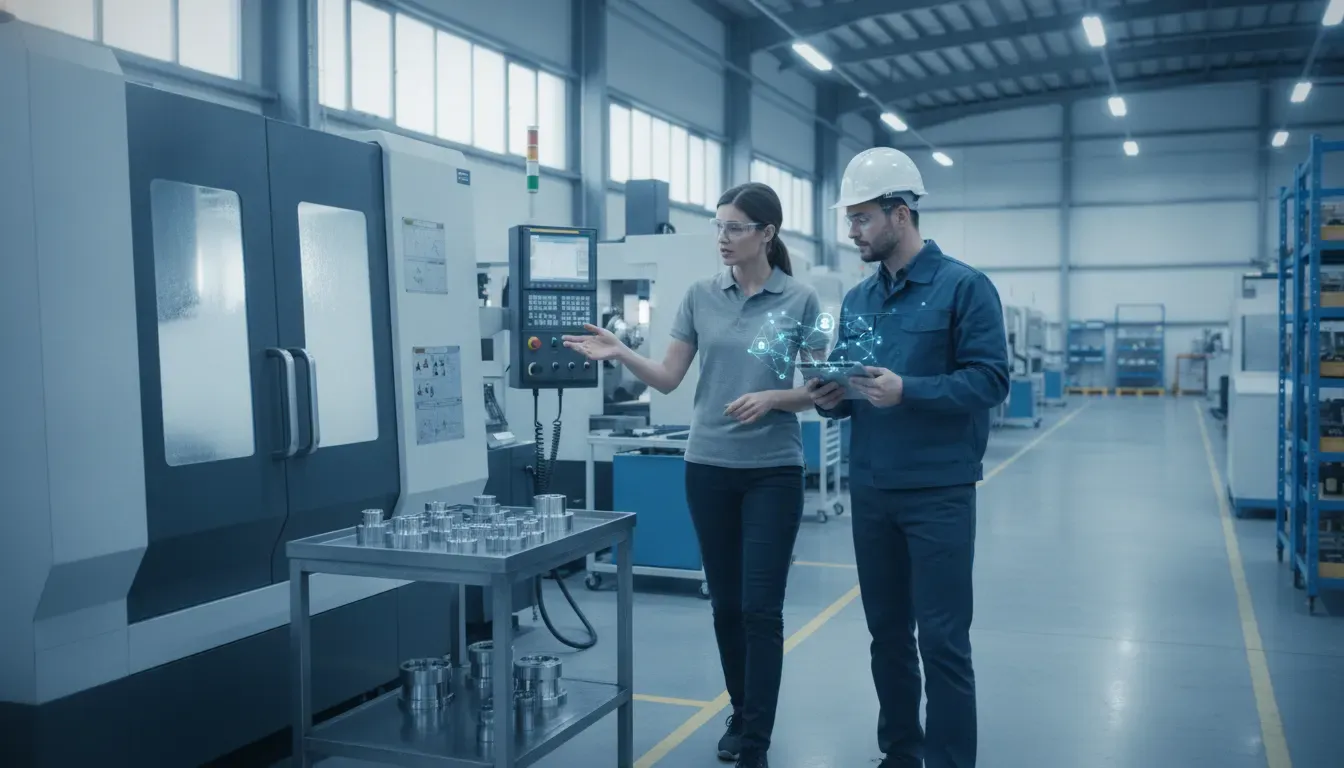
For many small and mid-sized discrete manufacturers, the first step is not a fully autonomous factory. It is a dependable connection between the ERP, the production schedule, the shop floor, and actual machine or job status. That foundation makes later investments easier to evaluate because the plant can see whether a change improved the constraint it was meant to solve.
What should manufacturers consider before investing?
Before investing in advanced manufacturing, evaluate the complete operating environment: products, processes, equipment, software, people, data, maintenance, cybersecurity, and financial objectives. A technically impressive solution may still fail if it cannot integrate with existing systems or fit how work is actually performed.
- Use-case fit: Does the technology address a defined production constraint or only add another source of information?
- Integration: Can it exchange the required orders, routings, schedules, machine events, quality results, and completion data with current systems?
- Data quality: Are names, units, event codes, routings, and timestamps consistent enough to support decisions?
- Operational ownership: Who will maintain the equipment, master data, interfaces, models, work instructions, and escalation rules?
- Workforce readiness: Do employees have the training and authority needed to use the new process safely and consistently?
- Scalability: Can the pilot expand to other machines, product families, plants, or ERP environments without a complete redesign?
- Security and resilience: How will the plant protect connected assets, manage access, recover from outages, and continue production when a system is unavailable?
- Measurement: What baseline and review cadence will determine whether the investment is creating operational value?
These questions help separate a useful transformation from a technology showcase. Advanced manufacturing is not a race to adopt every new tool. It is a disciplined way to improve the physical and information systems that turn materials into products.
Frequently asked questions
Advanced manufacturing is broad, so the best definition depends on the process and outcome being discussed. The answers below summarize the practical distinctions plant leaders most often need when evaluating a modernization project.
Is advanced manufacturing the same as smart manufacturing?
No. Smart manufacturing usually emphasizes connected data, automation, and adaptive decision-making. Advanced manufacturing is broader and can include new materials, advanced processes, equipment, workforce practices, and digital systems, whether or not the operation is fully connected.
What is an example of advanced manufacturing for a job shop?
A job shop might connect CNC machines to monitor status, use finite-capacity production scheduling, capture operator and job events digitally, and feed actual results back into planning. It could also use robotic machine tending, advanced inspection, or additive manufacturing for a specific tooling need.
Does advanced manufacturing require artificial intelligence?
No. AI can support forecasting, anomaly detection, and optimization, but advanced manufacturing also includes robotics, additive processes, advanced machining, sensors, inspection, simulation, integration, and improved standard work. Reliable data and a clear use case matter more than adding AI to a project.
What is the first step toward advanced manufacturing?
Define one measurable production constraint and document the current process. Establish a baseline, verify the available data, choose a bounded pilot, and involve the people who will operate and maintain the new process. This reduces risk and makes the result easier to evaluate.
How does production software support advanced manufacturing?
Production software can connect planning and execution by combining orders, routings, capacity, schedules, machine status, shop-floor events, and analytics. It does not replace a robot or machining process. It helps the plant coordinate those resources and make decisions using current operational information.
Advanced manufacturing works best when each technology has a job to do and the plant can measure the result. For discrete manufacturers, connecting production scheduling, machine visibility, shop-floor data, and analytics can provide a practical foundation for the next improvement without requiring an all-at-once transformation.